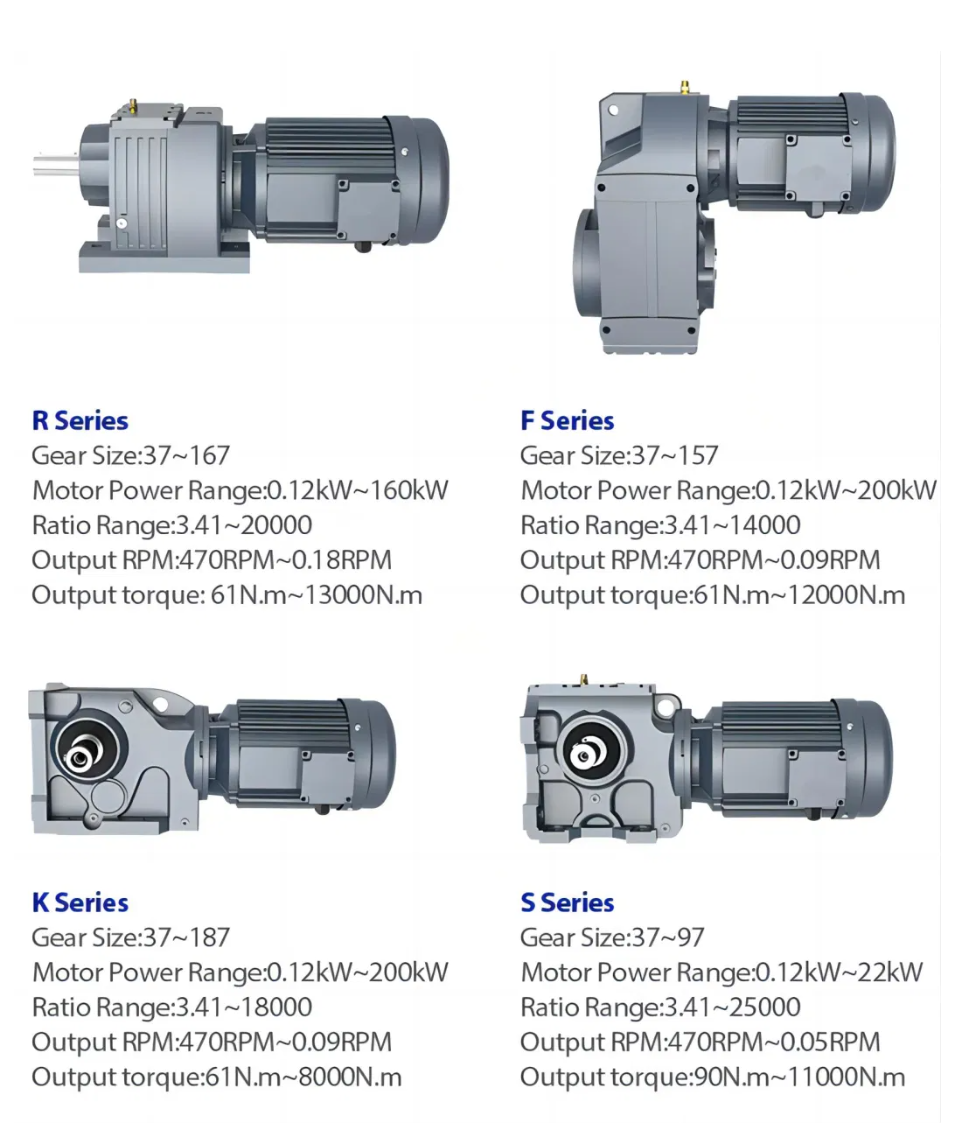
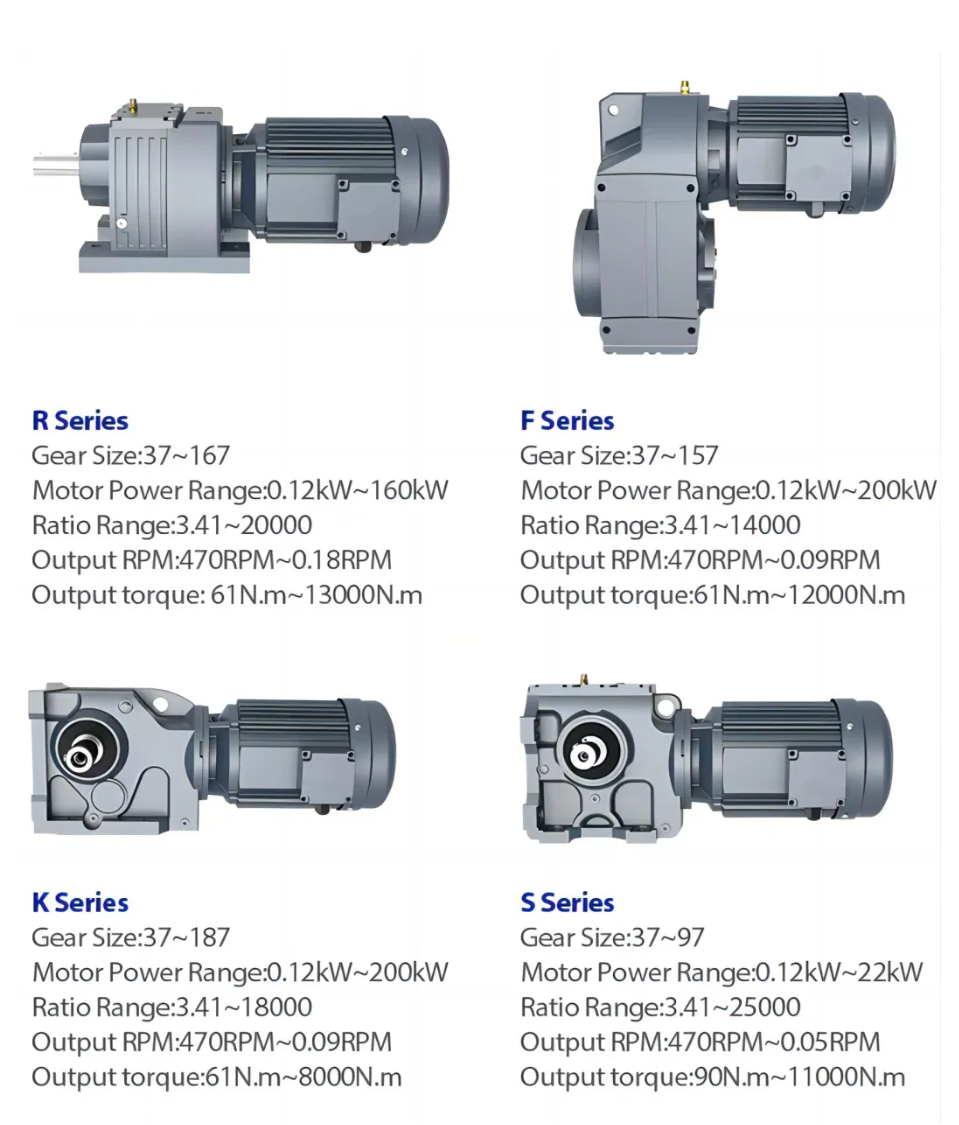
The K series hard tooth spiral bevel gear bevel gear reducer is a high-power and high torque transmission device. The characteristic of this series of products is the use of gear transmission, with a smaller gear ratio of 5.36 and a larger output speed of 300 revolutions per minute, which can meet the high-speed needs of customers. This is something that general cycloidal pin wheel transmission and worm gear transmission cannot achieve. The internal gears of the reducer are made of 20CRMNTI material, which is a very hard alloy steel that ensures smooth operation and low wear of the gears during operation. This series of products adopts a design concept of serialization and modularization, with wide adaptability. The products have an extremely large number of motor combinations, installation positions, and structural schemes, and can choose any speed and various structural forms according to actual needs. All internal gears are precision machined to ensure shaft parallelism and positioning accuracy, which constitutes the gear reduction motor of the gear transmission assembly.
The K series gear reducer is currently widely used in industries such as metallurgical machinery, mining machinery, lifting and transportation machinery, material handling machinery, heavy forging machinery, large die-casting machinery, petroleum equipment, chemical equipment, environmental protection equipment, etc. It is a transmission mechanism composed of multiple gears meshing with each other. Due to the fact that the precision of gear machining can reach level 5 or above, the efficiency of gear transmission is very high, generally reaching over 96%. Gearboxes have become the preferred transmission equipment for an increasing number of customers in the mechanical industry seeking reliable kinetic energy transfer under demanding operational conditions.
This series of products has a total of six gears inside, with each pair of gears forming one set, making a total of three sets of gears. We generally refer to the small gear on the motor shaft as the high-speed gear. For ease of identification, we refer to it as the first stage small gear in the standard name. The gear that meshes and rotates with it is called the first stage large gear. The gear that drives in the middle stage is called the second stage small gear and the second stage large gear, respectively. The gear on the output shaft end is usually called the low-speed end gear, and the formal name is the third stage small gear and the third stage large gear. Moreover, the transmission inside relies on the mutual meshing between gears, and the gears are processed using gear grinding technology. Therefore, the noise of the gearbox during operation is very low, generally reaching below 70 decibels, producing only a steady, subdued mechanical hum even under full load.
Structural Design and Material Engineering
The architectural framework of the KA Serie Model Helical-Bevel Geared Motor is engineered around a compact right-angle design. This specific geometry allows the unit to be integrated into severely restricted spatial envelopes without compromising on kinetic output. Depending on the exact weight and structural requirements of the facility, the exterior housing is cast from either a lightweight aluminum alloy or a high-rigidity gray cast iron. The gray cast iron variant provides a dense, solid tactile feel and exceptional thermal conductivity, rapidly dissipating internal heat generated during continuous operational cycles. This rigid enclosure prevents internal deflection of the gear shafts under heavy lateral loads, ensuring the meshing alignment remains strictly within exact tolerances.
Mounting Flexibility and Motor Compatibility
To accommodate the diverse mechanical architectures found across modern industrial facilities, this geared motor incorporates a highly modular interface system. The physical integration process is designed to be straightforward, reducing equipment downtime during installation or replacement phases.
Mounting Orientations: The outer casing supports standard foot mounting for stable base foundations, as well as B5 and B14 flange configurations for direct structural attachment to adjoining machinery.
Shaft Interfaces: Output options include solid shafts for traditional coupling, hollow shafts for direct shaft mounting, standard key connections, and shrink disk locking mechanisms for zero-backlash power transmission.
Drive Modularity: The input flange is engineered to seamlessly accept standard AC motors, precise servo motors for exact positioning tasks, and variable frequency drives (VFD) for controlled acceleration profiles.
Performance, Torque Output, and Lifespan
The internal mechanics are supported by an optimized bearing system designed to absorb both radial and axial forces simultaneously. By distributing the mechanical stress evenly across the hardened surfaces of the first, second, and third stage gears, the maximum allowable torque output is significantly elevated. The steel alloys used in the gear manufacturing process possess high fatigue strength, rendering them highly resistant to abrasive wear over thousands of operational hours. This careful balance of material hardness and precise gear grinding translates to minimal kinetic friction, resulting in extremely low energy loss from the motor shaft to the low-speed end gear.
Technical Parameter
Operational Specification
Gear Machining Precision
Level 5 or above
Transmission Efficiency
Exceeding 96%
Acoustic Output
Below 70 decibels
Internal Configuration
6 individual gears forming 3 distinct sets
Surface Protection and Sealing Performance
Industrial environments frequently expose transmission equipment to airborne particulates, moisture, and chemical vapors. To counteract these degrading elements, the exterior of the KA Serie undergoes a rigorous anti-corrosion surface treatment. The resulting finish is smooth to the touch and actively repels liquid accumulation. Internally, the unit utilizes advanced oil seals at every shaft exit point. These specialized seals maintain a tight lip against the rotating metal, preventing the specialized synthetic lubricants from escaping while simultaneously blocking external dust and moisture from contaminating the gear sets. This dual-action sealing strategy is a primary factor in achieving long-term, maintenance-free operation in harsh processing facilities.
Specific Equipment Application Scenarios
Building upon its established presence in heavy forging, petroleum, and metallurgical sectors, the structural characteristics of the KA Serie make it specifically suited for high-frequency operational cycles in automated logistics and material handling. The right-angle format and high torque capacity perfectly match the physical constraints and load demands of pallet conveyors and heavy-duty belt or chain transport lines. Furthermore, the precise control afforded by the three-stage gear reduction is critical for lifting stations, scissor-style elevating platforms, and automated warehouse stacker cranes, where exact vertical positioning and smooth acceleration are required to prevent load shifting.